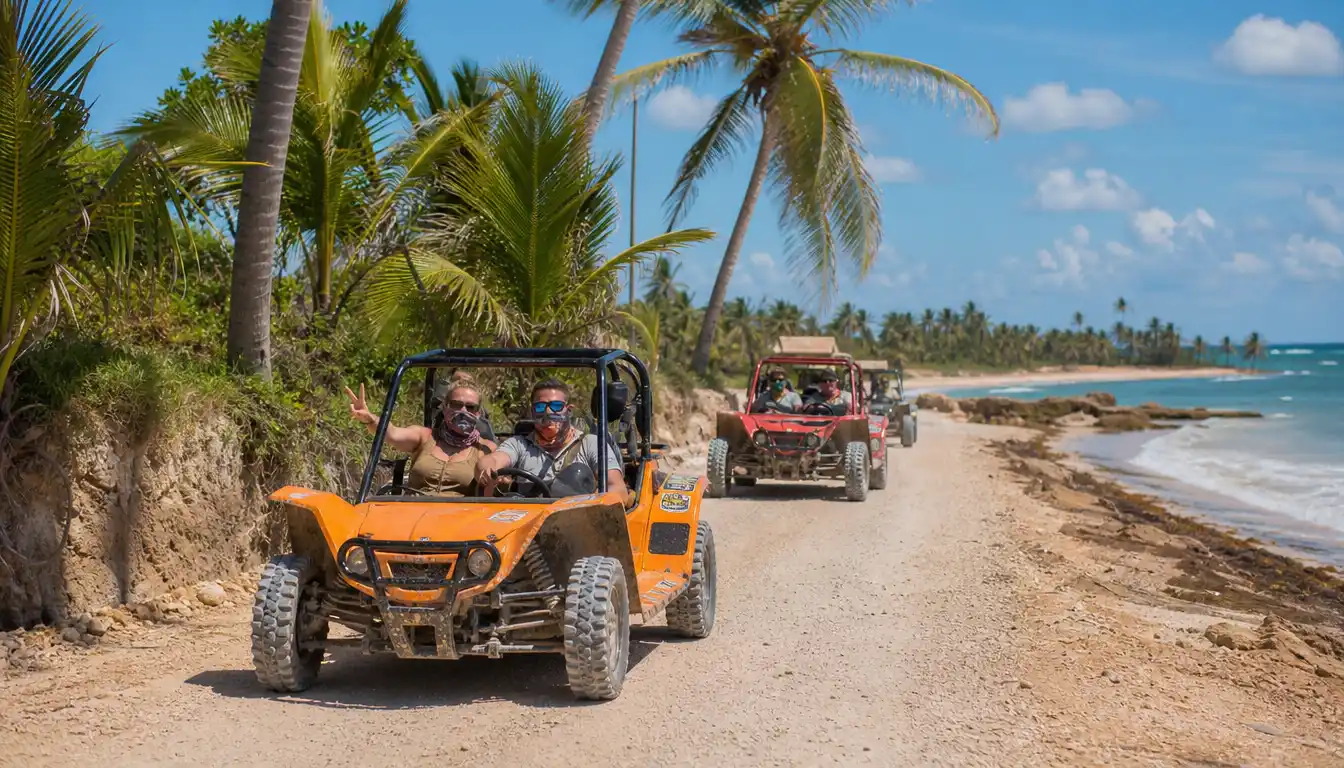
Macao Beach and Jungle Buggy Tours in Punta Cana
My mouth tasted like limestone grit before we even reached the halfway point. You don't realize how much dirt an unpaved Dominican road kicks up until you are trailing five yards behind a battered twin-cylinder engine revving at full throttle through a banana grove. If you booked a beach buggy tour punta cana thinking it would be a leisurely ride down a paved coastal avenue with ocean breezes gently ruffling your hair, you are in for a shock. It is loud, messy, and rough on the kidneys, which is precisely why hundreds of travelers sign up for it every single morning.
The standard route between the staging ranches outside Bavaro and the open sands of Macao Beach remains the quintessential off-road trek in the Dominican Republic. Over four or so hours, you get shoved into a mix of deep Dominican red clay, limestone swimming holes, rural backyards with roaming chickens, and an untouched stretch of Atlantic beachfront that hasn't been swallowed by megresorts yet. Here is what really happens out on those dirt trails, what to look out for, and how to survive the day without ruining your favorite clothes or your mood.
Book your buggies tour punta cana experience:
What to Expect on a Beach Buggy Tour Punta Cana Run
Most people get picked up at their resort lobby between 7:45 AM and 8:20 AM. The transport is usually an open-air safari truck with wooden benches in the back, though some companies send standard air-conditioned minivans depending on how far south your hotel sits. You will spend anywhere from 25 to 50 minutes collecting other passengers from surrounding resorts. It is slow going, honestly, and the lobby waits can test your patience. Once you turn off the smooth highway onto the rutted access tracks near El Salado, the pavement disappears completely.
The staging ranch looks chaotic. You step down into a yard packed with dozens of open-frame buggies lined up like mechanical beetles. Some have roll cages painted bright yellow or safety orange, while others show bare metal welded together after years of abuse. Mechanics in grease-stained t-shirts rev engines, check oil levels with rags, and point you toward a wooden counter where you get fitted for helmets. They will try hard to sell you bandanas and cheap plastic sunglasses for $10 each. Bring your own, or pay the convenience tax on the spot.
Driving these rigs takes some physical effort. Most entry-level buggies run on modified 250cc or 300cc lawnmower or go-kart style engines with automatic transmissions. There are two pedals on the floor: gas on the right, brake on the left. The steering has zero power assist, meaning every rock and rut in the dirt jerks the wheel hard against your palms. If you hit a patch of washboard mud at 20 miles per hour, your teeth will rattle in your jaw. It is tiring on your forearms, but after ten minutes, you find a rhythm.
The convoy format is mandatory. You will not be allowed to blast off across private farm fields on your own. A lead guide sets the pace from the front, while two or three mechanic guides buzz up and down the flanks on dirt bikes, herding stragglers and fixing thrown belts. If someone stalls in a puddle, a guide jumps off his bike, reaches into the engine bay with bare hands, tugs a wire, and gets them moving again in roughly 30 seconds.
Note: The mud around Macao contains high iron content from the red clay soil. It will permanently dye white fabrics, light-colored swimsuits, and light gray sneakers a stubborn orange-brown color that survives multiple hot laundry cycles.
The Wild Run to Macao Beach: Why This Coastline Matters
Playa Macao is the crown jewel of this trail network. Unlike the manicured, weeded sands of Bavaro where guards patrol private hotel perimeters, Macao remains one of the few public beaches in the region with an untamed character. Atlantic swells roll straight in without a protective barrier reef, throwing heavy shorebreak against the amber sand. It is loud, breezy, and framed by high limestone cliffs on the southern end.
When your convoy finally breaks through the coconut palms and hits the hard-packed sand, the guides usually give you 20 to 30 minutes of free time. You park in rows above the tide line. The ocean looks tempting, but the waves here demand caution. Rip currents are common near the cliffs, so if you go in, stick to waist-deep water where you can plant your feet firmly into the sandbar.
The scene on the beach moves fast. Local vendors will approach you offering wooden crafts, shell necklaces, cold Presidente beer, and fresh coconuts cracked open with a single machete stroke. If you want a coconut, expect to pay around $3 or 150 pesos. If you do not want to buy anything, a polite, firm "no, gracias" accompanied by a smile will keep them moving down the line toward the next buggy driver.
- The surf break: Macao has real waves, making it the premier local surfing beach rather than a calm swimming pool.
- Cliff views: The jagged limestone point to the south provides a panoramic angle over the entire bay if you have time to walk over.
- Local fish shacks: Simple wooden stalls tucked beneath the palms fry whole snapper with plantains over gas burners, smelling of garlic and saltwater.
- Raw coastline: There are no hotel loungers or manicured grass borders here, just miles of driftwood, golden sand, and Atlantic ocean.

Into the Interior: The Real Jungle Buggy Tour Experience
Leaving the coast behind, the track ducks inland through dense scrub forest and agricultural parcels. This is the jungle buggy leg of the journey, where the canopy thickens and the ambient temperature jumps five degrees in seconds. The air smells damp, rich with decaying vegetation, wild basil, and cow manure from small roadside pastures. Puddles here do not evaporate quickly; they sit in sunken dirt hollows, turning into thick, soup-like wallows that coat your legs and chassis in heavy brown sludge.
Most itineraries include a stop at a traditional rancho or Dominican cultural outpost. It is undeniably tourist-oriented, but interesting enough if you have never seen how basic commodities grow. Guides walk you past living coffee bushes, cacao trees with heavy pods dangling from the trunks, and wild tobacco plants drying in open-sided thatch barns. You sit on wooden benches while someone demonstrates grinding roasted cocoa beans with a pestle, passing around small cups of hot spiced chocolate and shots of sweet mama juana brewed with tree bark, rum, red wine, and honey.
You can buy bags of cocoa balls, vanilla extract, and cheap cigars here. You are under no obligation to purchase, though leaving a dollar or two in the tasting tip box is polite. If you want to compare how these stops fit into different overall pricing brackets, taking a look at Punta Cana buggy tour prices helps map out which packages bundle everything together and which hit you with add-on fees.
The cave stop comes next on almost every half day buggy tour punta cana route. The most famous is Cueva Taina, an underground freshwater cenote reached by descending a slippery set of stone stairs cut directly into the coral rock. Down below, the air turns cool and still. A pool of clear, emerald-tinted water sits illuminated by hanging floodlights, surrounded by stalactites dripping moisture from the ceiling. Rinsing the road grit off your skin in that cold spring water feels incredible, even if thirty other muddy travelers are sharing the pool with you.
Pro tip: Slip a pair of cheap neoprene water shoes into your pocket. The submerged limestone rocks inside the cave pools are jagged and slick, making barefoot walking slow and painful.
Book your buggies tour punta cana experience:
Comparing Your Ride: Standard Buggy vs Side-by-Side
Not all tour buggies macao punta cana fleets use the same machinery. Your physical comfort depends heavily on whether you choose a baseline open buggy or spend extra money on a brand-name utility vehicle. The basic models have thin vinyl seats, raw metal frames, and very little suspension travel, which means every root impacts your spine directly. Modern side-by-sides provide deep bucket seats, four-point harnesses, and heavy-duty coil shocks that swallow deep ruts with ease.
If you prefer better suspension, exploring Polaris and VIP side by side buggies will give you a clear look at how those premium machines handle the exact same trails. Here is how the standard options stack up side by side for a typical morning run:
| Vehicle Type | Engine Setup | Comfort Level | Typical Mud Factor | Approx. Cost per Buggy |
|---|---|---|---|---|
| Standard 2-Seater Buggy | 250cc-300cc Go-kart | Low (thin padding, stiff frame) | Extreme (no wheel arches) | $65 - $85 |
| Family 4-Seater Buggy | 350cc-400cc Rear engine | Moderate (bench rear seats) | Heavy (back passengers get sprayed) | $110 - $140 |
| Polaris RZR / VIP UTV | 800cc-1000cc Dual cylinder | High (long-travel suspension) | Moderate (flared fenders help) | $160 - $220 |
The rear passengers on four-seater buggies usually take the worst beating from the mud. Because the tires stick out wider than the light tubular chassis, the front wheels spray brown water directly backward into the open cockpit. If you sit in the second row, keep your mouth closed whenever the driver steps on the gas through standing water.

Survival Logistics: Packing, Dirt, and Scheduling
Do not wear anything you love. Treat your tour wardrobe as disposable. Dark clothing is best, preferably quick-drying synthetic fabric that does not hold water like heavy denim or thick cotton. Old running shoes or secure hiking sandals with heel straps are essential; flip-flops will slip off the pedals while driving and get suctioned off your feet in the mud at the cave entrance.
Bring cash. Small bills rule the countryside. You will need cash for tips for the trail mechanics who grease your chains and rescue your stalled engine, cash for bandanas at the staging depot, and money for cold water or beers along the route. Around $30 to $40 in small-denomination dollars or Dominican pesos will cover two people comfortably without worrying about making change.
- Eyewear is mandatory: Standard sunglasses work, but cheap wrap-around safety glasses from a hardware store seal the perimeter around your eyes far better against flying gravel.
- Water protection: Put your phone inside a certified waterproof pouch that hangs around your neck beneath your shirt, not in your back pocket where it can slide out.
- Bandana or neck gaiter: A dry bandana tied tightly over your nose and mouth keeps the powder dust out of your lungs during the dry stretches between mud holes.
- Sunscreen application: Put sunscreen on before leaving your resort, not at the ranch. Applying cream over fresh trail dust creates an abrasive paste on your face.
Deciding between the morning and afternoon departures comes down to weather and heat. The morning run leaves early, around 8:30 AM, meaning cooler temperatures while you drive through the exposed farm roads. The afternoon group, departing around 1:30 PM, encounters a trail baked dry by midday heat, creating much more dust unless it rained an hour prior. If it rained heavily the night before, congratulations: you are going to get soaked in orange water from chin to ankle, which is frankly half the fun of a jungle buggy tour.
Frequently Asked Questions about beach buggy tour punta cana
Can children participate in this excursion?
Yes, children as young as four or five can ride as passengers in family-style buggies with seatbelts, but they cannot drive. Driving requires a valid driver's license, and drivers must usually be at least 18 years old.
Are there lockers at the staging ranches?
Most ranches have small wooden lockers available for rent for roughly $5, but spaces are limited. It is far safer to leave passports, expensive jewelry, and extra electronics in your hotel room safe.
Do I need an international driver's license to drive?
No, your standard domestic driver's license from your home country or state is completely sufficient for the tour guides to let you take the wheel.
What happens if our buggy breaks down along the trail?
Traveling mechanics trail each group on dirt bikes equipped with tool rolls. They fix thrown belts or spark plugs in minutes, or pull up a spare buggy from the support convoy so you never get left behind in the jungle.
Quick Reference
- Total excursion time: ~4 hours hotel to hotel
- Actual driving time: ~2 to 2.5 hours on the trails
- Main stops: Macao Beach, Taino Cave pool, traditional cocoa ranch
- Terrain: Red clay, rocky gravel, deep mud puddles, beach sand
Book your buggies tour punta cana experience:
Is It Worth It?
If you hate getting dirty, despise engine fumes, or want a quiet, pristine afternoon admiring ocean waves, skip this excursion completely. It is raw, touristy in spots, and genuinely chaotic. But if you want to throttle an engine down narrow dirt corridors, plunge into a freezing freshwater cave beneath limestone rocks, and taste salt spray on a wide-open Atlantic beach, a Macao beach buggy run gives you an energetic break from resort routine. Just throw away your dirty t-shirt when you get back, wash the clay from behind your ears, and you will have one of the best stories from your Dominican vacation.
Read more about buggies tour punta cana.